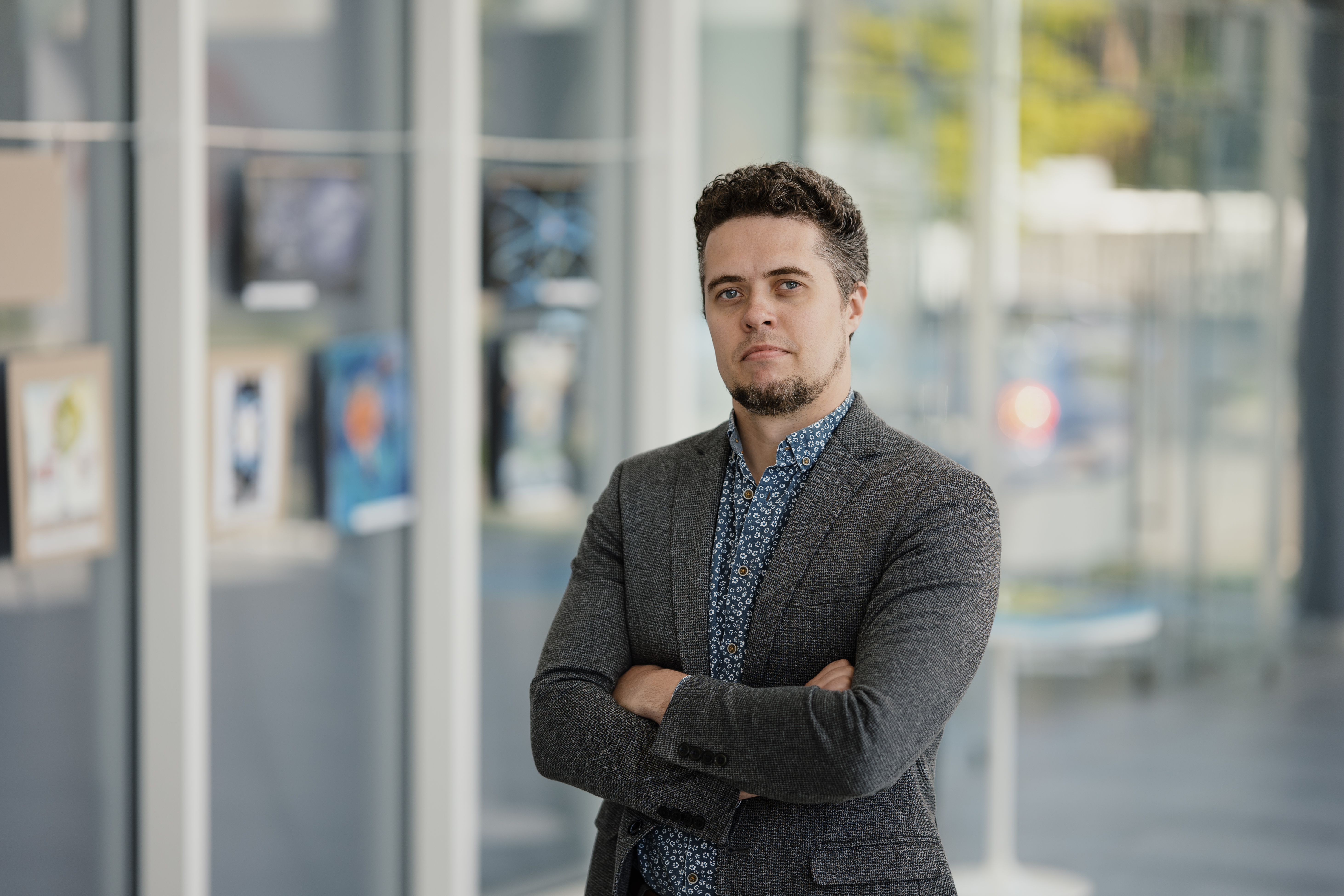
 Last year, Dr Mantas Šimėnas, a researcher at the Institute of Applied Electrodynamics and Telecommunications at the Faculty of Physics of Vilnius University (VU), was awarded a prestigious Marie Skłodowska-Curie Postdoctoral Fellowship grant. Today, halfway through the project, the physicist says that this financial instrument is beneficial for many reasons: "A financially generous grant is not only science-oriented but also researcher-oriented, as it aims to create the conditions for a successful career as a scientist".
Adequate funding for researchers and mobility
"The Marie Skłodowska-Curie grant is both a prestigious and a generous funding instrument. As well as enriching a researcher's CV, the grant has other advantages. In addition to a good salary for the researcher, the grant also opens up opportunities for international mobility, as the funds can be used for traineeships in other countries around the world, which, in turn, is important for developing the researcher's expertise. I have just returned from a one-month internship at the ETH Zurich (Switzerland)", says Dr Šimėnas.
The scientist highlighted that this funding instrument provides the freedom to research. At the same time, it is geared towards growth by building a solid foundation for the researcher's professional life. Dr Šimėnas has no doubt that this grant will have a positive impact on my career", and he believes it will be instrumental to his further progress: "Finally, the preparation and execution of the Marie Skłodowska-Curie Postdoctoral Fellowship application are linked to other European Commission (EC) funding tools. I plan to apply for larger grants in the future. The experience gained should provide a serious competitive advantage".
Work in a world-leading VU laboratory
When asked why he decided to return to Lithuania after spending several years at one of the world's top universities in the UK and why he chose VU for his MSC postdoctoral fellowship project, Dr Šimėnas explained that, in terms of science, Lithuania is catching up with the prestigious institutions quite quickly. "In addition to the personal appreciation, the award reflects the importance of the research carried out in the Institute for Applied Electrodynamics and Telecommunication at a global scale. My work at the VU Microwave Spectroscopy Laboratory is not significantly different, in terms of technology, from what I was doing at University College London, where I did my postdoctoral fellowship", says Dr Šimėnas.
According to Dr Šimėnas, the Microwave Spectroscopy Laboratory, headed by Prof. Jūras Banys, has an extensive knowledge base on microwaves and is equipped with the necessary equipment to conduct microwave-related research and develop new technologies.
"The facilities my colleagues and I have developed allow our laboratory to be a world leader in applying cryogenic microwave amplifiers in electron paramagnetic resonance (EPR) spectroscopy. I am using them to achieve one of the goals of my research project – to measure electron spins as efficiently as possible", explains Dr Šimėnas, whose Marie Skłodowska-Curie-funded research 'Shaping the future of EPR with cryoprobes and superconducting microresonators (SPECTR)' involves the development and application of a new technique for the use of cryogenic microwave amplifiers for EPR research.
Aiming to reduce experimental time and improve the sensitivity of the equipment
Dr Šimėnas explains: "EPR spectroscopy is a widely used tool for studying electron spins in systems ranging from protein structures to quantum technologies. The current goal is to apply EPR to study tiny numbers of spins, which requires exceptional improvements in EPR equipment".
Since the measurement of electron spins can take a long time – up to a week – one of the aims of Dr Šimėnas' research is to shorten the time of the experiment considerably: "Our group has pioneered the use of cryogenic microwave amplifiers in EPR research, and these amplifiers allow us to reduce the experimental time by up to 100 times. Such improvements open new avenues for EPR research in biochemical, solid-state, and quantum systems. In the future, these improvements will allow ultra-small amounts of proteins or electron spins implanted in materials for quantum technologies to be measured".
The researcher also aims to increase the sensitivity of EPR studies by using microresonators. These exciting ultra-small structures allow the measurement of microscopic samples, such as a single bacterium.
Applications range from medicine to quantum technology
"Because electron spins are present in a wide range of materials, EPR can be widely used in many fields. EPR can be used to determine the structure of proteins, the basic building blocks of life. Drugs work on proteins, so studying their properties can be important in treating various diseases", explains the researcher.
EPR is also widely used in physics. The technique can be used to ascertain specific details regarding material properties. The microscopic structure of a material and thus related phenomena such as phase transitions can be deduced by probing the electron spins.
"Spin is also related to another area that is very important at the moment – quantum technologies – because spin can be used as a qubit (quantum bit), as microwaves can control it. The qubit is, therefore, the foundation of all quantum technologies. This is also something we are focusing on, just not in the framework of this grant", Dr Šimėnas clarifies.
The essential advice is to leave enough time
"When applying for such a grant, I would suggest taking enough time to complete the application and assess things like the suitability of the institution and its support for the project. I am referring here to the infrastructure, the support in public procurement, etc. The application will have to show that the university can provide this support", notes the grantee.
He believes that, although the time it takes to complete the application will vary from person to person, leaving only a week to complete it is not a good idea: "You will also need to pay enough attention to the application. There is intense competition, so every sentence has to be honed and polished to the last detail. His other advice is simple: if you don't get it right the first time, take the reviewers' comments on board and try again next year".
Dr M. Šimėnas defended his PhD thesis titled ‘Electron paramagnetic resonance spectroscopy of hybrid metal-formate frameworks’ in 2018 (supervised by Prof. J. Banys) at VU. He is also the first Lithuanian to win the John Weill Young Investigator Award of the International Electron Paramagnetic Resonance (ESR) Society; Dr Šimėnas is also a member of the Young Academy of the Lithuanian Academy of Sciences and a recipient of the Marius Jakulis Jason and VU Foundation grants.
Marie Skłodowska-Curie Postdoctoral Fellowships are among the most prestigious flagship research fellowships in Europe, aiming to support researchers’ careers, enhance their creative and innovative potential, and foster excellence in research. Vilnius University invites motivated researchers with a strong track record to prepare joint applications for the call for proposals under this funding scheme (deadline: 13 September 2023).
Researchers applying for a Marie Skłodowska-Curie European Postdoctoral Fellowship with the host institution located in a Widening country (Lithuania is among the Widening countries) will have an extra opportunity to receive funding if their project is well-evaluated but not funded due to budgetary constraints, as their proposals will be automatically resubmitted to the call for ERA Fellowships.
Moreover, applicants whose Marie Skłodowska-Curie Postdoctoral Fellowship proposals submitted for the 2023 call reach the threshold score of 70% will have the opportunity to receive national funding for the implementation of their projects.


